Methodology
The project runs for twenty-four months. The first phase sets the requirements, selects the winding concept and builds the modelling tools. The second turns them into a detailed design, a manufacturing route and a test platform. The third validates performance, safety and durability, and translates the results into a certification-readiness roadmap. Management and communication run continuously across all three.
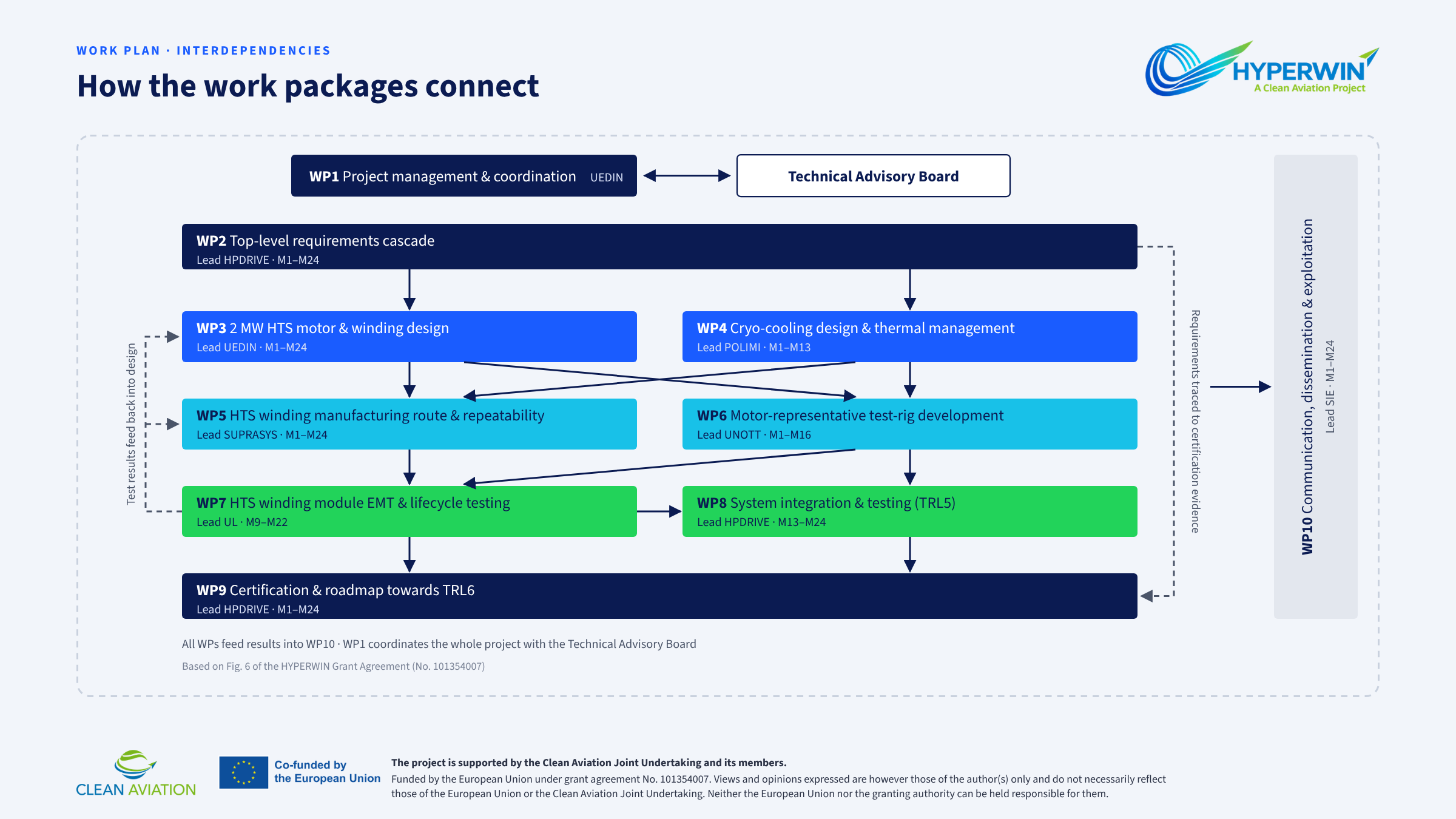
Top-level aircraft and propulsion requirements are cascaded to system, motor, winding and material level. The winding concept is selected and the multiphysics modelling toolchain is built and benchmarked. Work packages WP2, WP3 and WP4.
Detailed winding and cryogenic cooling design, a repeatable and quality-controlled manufacturing route for representative modules, and a motor-representative test rig ready for the validation campaign. Work packages WP3, WP4, WP5 and WP6.
Electro-magneto-thermal testing, quench and fault response, lifecycle testing and system integration deliver the TRL5 evidence, followed by the certification-readiness assessment and the roadmap to TRL6. Work packages WP7, WP8 and WP9.
WP1 management and coordination, and WP10 communication, dissemination and exploitation, run from M1 to M24.
Work packages
WP
Title
Lead
Months
WP1
Project management and coordination
UEDIN
M1–M24
WP2
Top-level requirements cascade
HPDRIVE
M1–M24
WP3
2 MW HTS motor and winding design
UEDIN
M1–M24
WP4
Cryo-cooling design and thermal management
POLIMI
M1–M13
WP5
HTS winding manufacturing route and repeatability
SUPRASYS
M1–M24
WP6
Motor-representative test-rig development
UNOTT
M1–M16
WP7
EMT and Lifecycle Testing of HTS Winding Modules
UL
M9–M22
WP8
System integration and testing
HPDRIVE
M13–M24
WP9
Certification readiness and TRL6 roadmap
HPDRIVE
M1–M24
WP10
Communication, dissemination and exploitation
SIE
M1–M24